


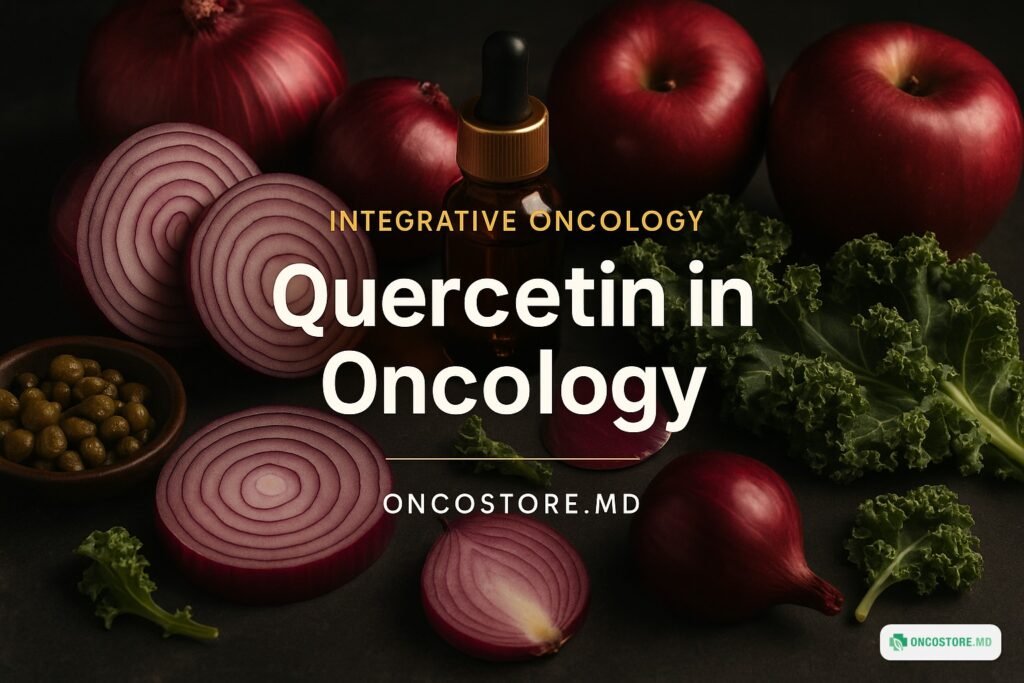
Quercetin is a plant flavonoid found in onions, apples, capers, kale and green tea — and one of the most thoroughly researched polyphenols in cancer biology. Its broad-spectrum antioxidant, anti-inflammatory and senolytic activity has made it a cornerstone of many modern integrative oncology protocols.
This guide covers the anti-cancer mechanisms, food sources, supplement forms, optimal dosage, and what current clinical evidence really shows about quercetin in cancer care.
What Is Quercetin?
Quercetin is a flavonol — a subclass of flavonoid pigments responsible for the yellow-to-red colors in many plants. It’s been studied since the 1930s, originally as ‘vitamin P’ for its blood-vessel-supporting effects.
Modern research recognizes quercetin as one of the most bioactive plant compounds, with activity in:
- Antioxidant defense (scavenges reactive oxygen species)
- Anti-inflammatory pathways
- Cell senescence (selectively kills aged ‘zombie’ cells)
- Anti-cancer mechanisms across multiple tumor types
How Quercetin Acts Against Cancer
Quercetin’s anti-tumor activity operates through several pathways:
- Apoptosis: activates intrinsic mitochondrial cell-death pathways in cancer cells
- Cell cycle arrest: halts proliferation at G1 and G2/M phases
- Anti-angiogenesis: inhibits VEGF signaling that builds tumor blood supply
- Anti-metastasis: reduces matrix metalloproteinase activity
- Senolytic effect: selectively eliminates senescent cells that secrete pro-inflammatory factors
- Chemo-sensitization: overcomes multi-drug resistance in some tumor lines
- Anti-inflammatory: suppresses NF-κB and COX-2 chronic inflammation pathways
Evidence by Cancer Type
Preclinical evidence is strong across multiple cancer types — clinical trials are growing:
- Prostate cancer: animal studies show suppressed tumor growth; small human trials show reductions in PSA
- Breast cancer: in vitro suppression of estrogen-driven cell proliferation
- Lung cancer: reduced metastasis in mouse models
- Colorectal cancer: protective in animal carcinogenesis models
- Leukemia: apoptosis induction in CLL and AML cell lines
- Pancreatic cancer: sensitizes resistant tumor cells to gemcitabine
Top Food Sources of Quercetin
- Capers: ~234 mg per 100 g (highest natural source)
- Red and yellow onions: ~20–50 mg per 100 g
- Apples (with skin): ~4–10 mg per 100 g
- Kale: ~7 mg per 100 g
- Green tea: 2–3 mg per cup
- Red wine: 1–2 mg per glass
- Berries (cranberries, blueberries): 2–5 mg per 100 g
- Buckwheat, broccoli, cherries
Eating 4–5 servings of quercetin-rich plants daily supplies ~30–50 mg — useful but below most therapeutic doses.
Supplement Forms and Bioavailability
Like curcumin, quercetin has poor inherent bioavailability. Improved forms:
- Quercetin Phytosome (Quercefit): bound to phospholipids, ~20× more bioavailable
- EMIQ (Enzymatically Modified Isoquercitrin): water-soluble, faster absorption
- Quercetin + Bromelain: traditional pairing aids absorption and adds anti-inflammatory action
- Quercetin + Vitamin C: recycles oxidized vitamin C, mutual potentiation
Quercetin Dosage Guidelines
- General antioxidant support: 250–500 mg daily
- Allergies/inflammation: 500 mg twice daily with bromelain
- Senolytic protocols: 500–1,000 mg pulsed (e.g., 2 days/month) often combined with fisetin or dasatinib under medical guidance
- Integrative oncology: 1,000–2,000 mg/day in divided doses, ideally as phytosome form
Safety and Considerations
Quercetin is generally well tolerated. Considerations:
- May interact with blood thinners — modest antiplatelet effect
- Inhibits CYP3A4 — can affect drug metabolism (statins, immunosuppressants, some chemo drugs)
- Caution in advanced kidney disease at very high doses
- Avoid in patients on cyclosporine without medical supervision
Frequently Asked Questions
Can quercetin help during chemotherapy?
Animal data and small trials suggest quercetin may sensitize tumors to certain chemotherapies and protect healthy cells. Coordinate with your oncologist before adding it during active treatment.
What’s the difference between quercetin and curcumin?
Both are polyphenols with anti-inflammatory and anti-cancer activity, but they target different pathways. Many integrative protocols use them together for complementary effects.
Is quercetin safe long-term?
Up to 1,000 mg daily for several months has been used safely in trials. For long-term high-dose use, periodic medical review is wise.
Can I get enough quercetin from food alone?
Diet supplies ~25–50 mg per day at best. For therapeutic effects in cancer support, supplements are usually needed.
What’s a senolytic and does quercetin really work?
Senolytics selectively remove aged ‘zombie’ cells. Quercetin combined with fisetin (or dasatinib in some protocols) has shown senolytic activity — current research is exploring this as a longevity and cancer-prevention strategy.
Disclaimer: This article is for educational purposes only. Always consult a qualified healthcare professional before starting any prescription medication or supplement.
What Our Customers Are Saying
Real stories from people just like you. Don’t take our word — read theirs.
“Started Quercefit alongside my naturopath’s recommendation. Allergy symptoms gone, inflammation markers down. Subtle but consistent.”
“I recommend quercetin + bromelain for many of my chronically inflamed patients. Predictable, well-tolerated, evidence-supported.”
“PSA stable for 18 months on active surveillance. Quercetin and lifestyle are part of my approach. Doctor supports it.”
“Reduced flare frequency by half over three months. Combined with diet changes — hard to credit one thing alone but I’m staying on it.”
“The combo formula made a real difference for my sinus inflammation. Year-round relief now.”